You don't need another AI tool.You need a colleague.
Sharper thinking. Honest risks. Decisions that hold up in every room.

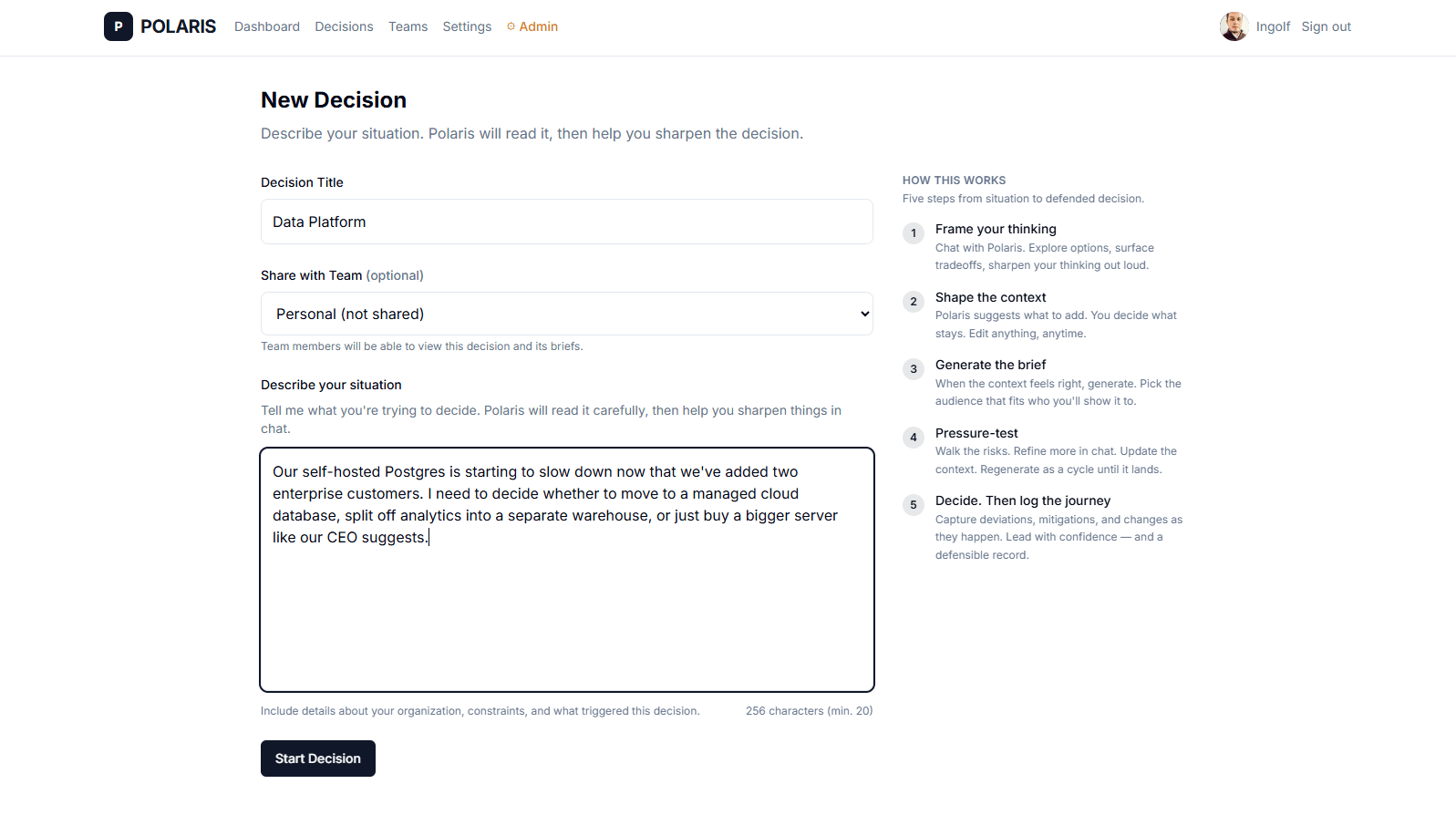
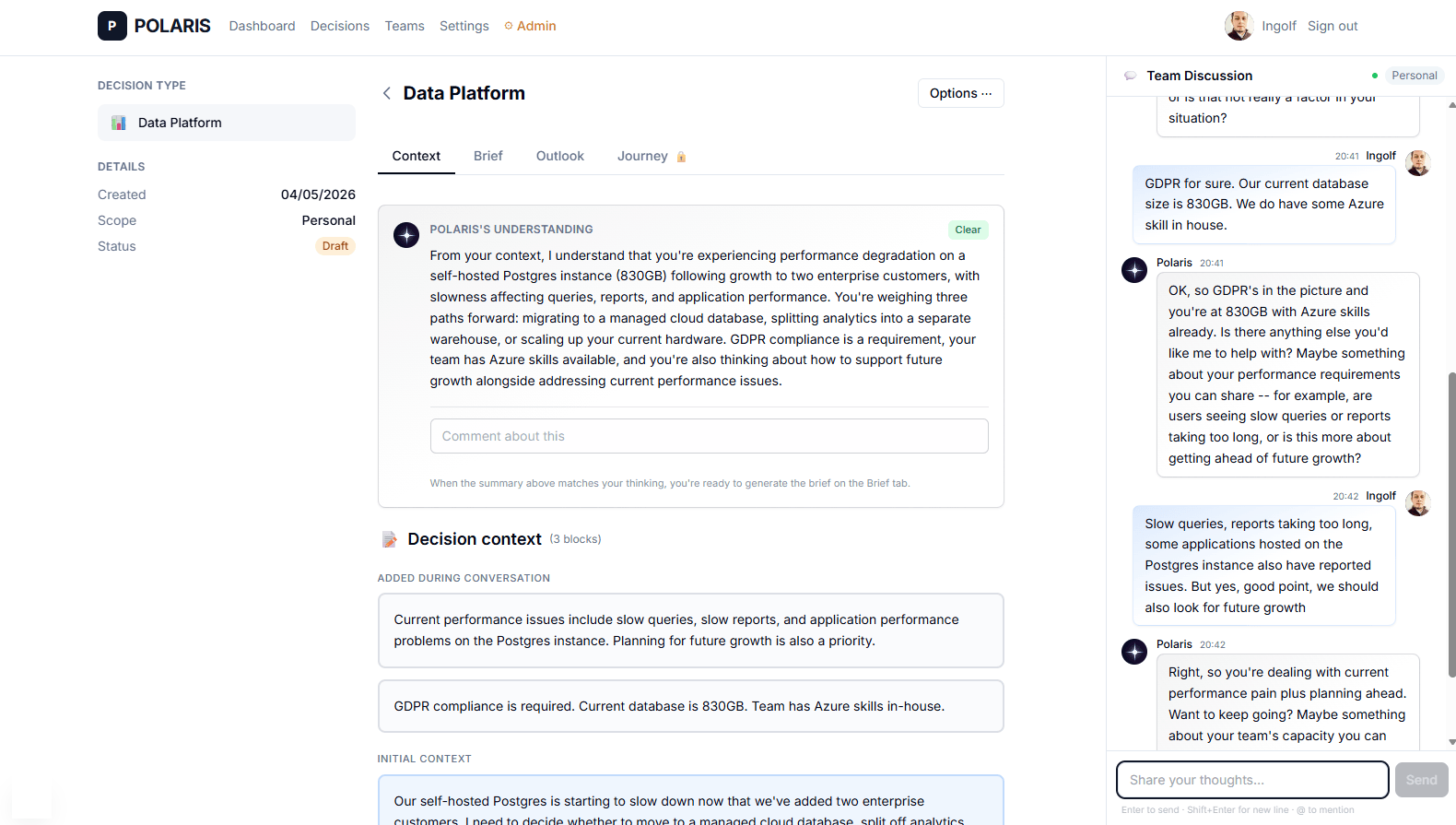
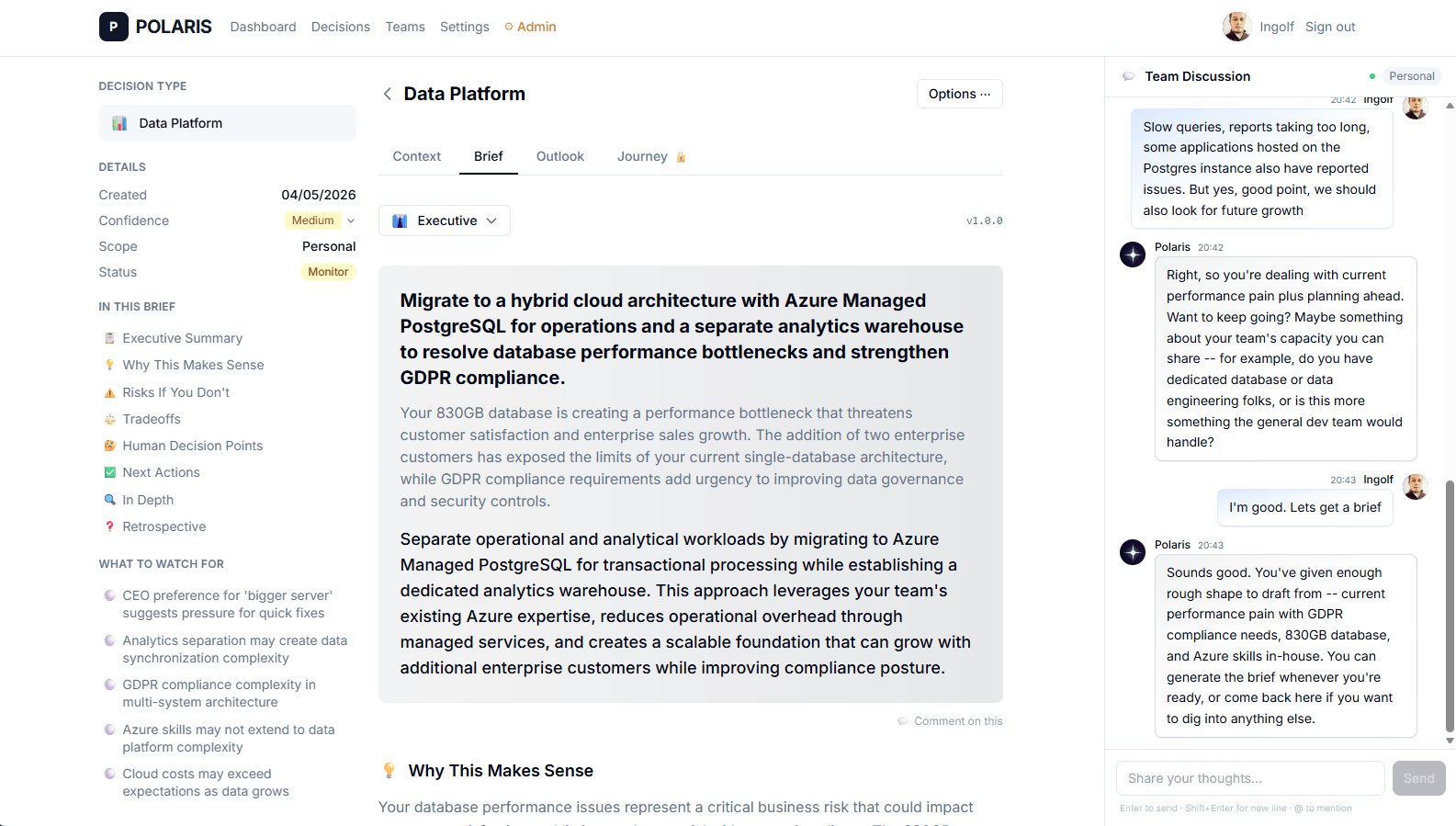
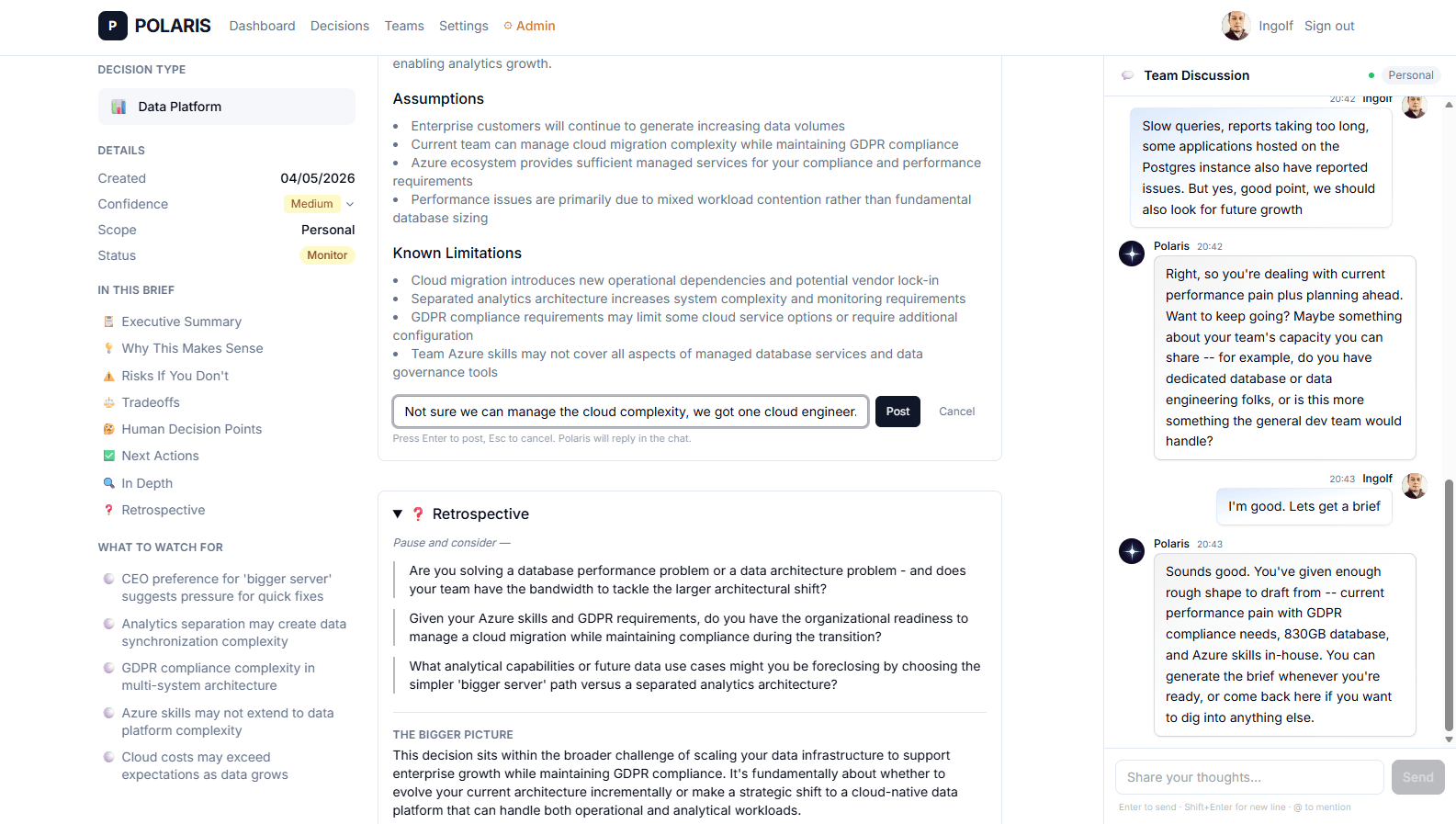
How it works
A continuous cycle of thinking, together.
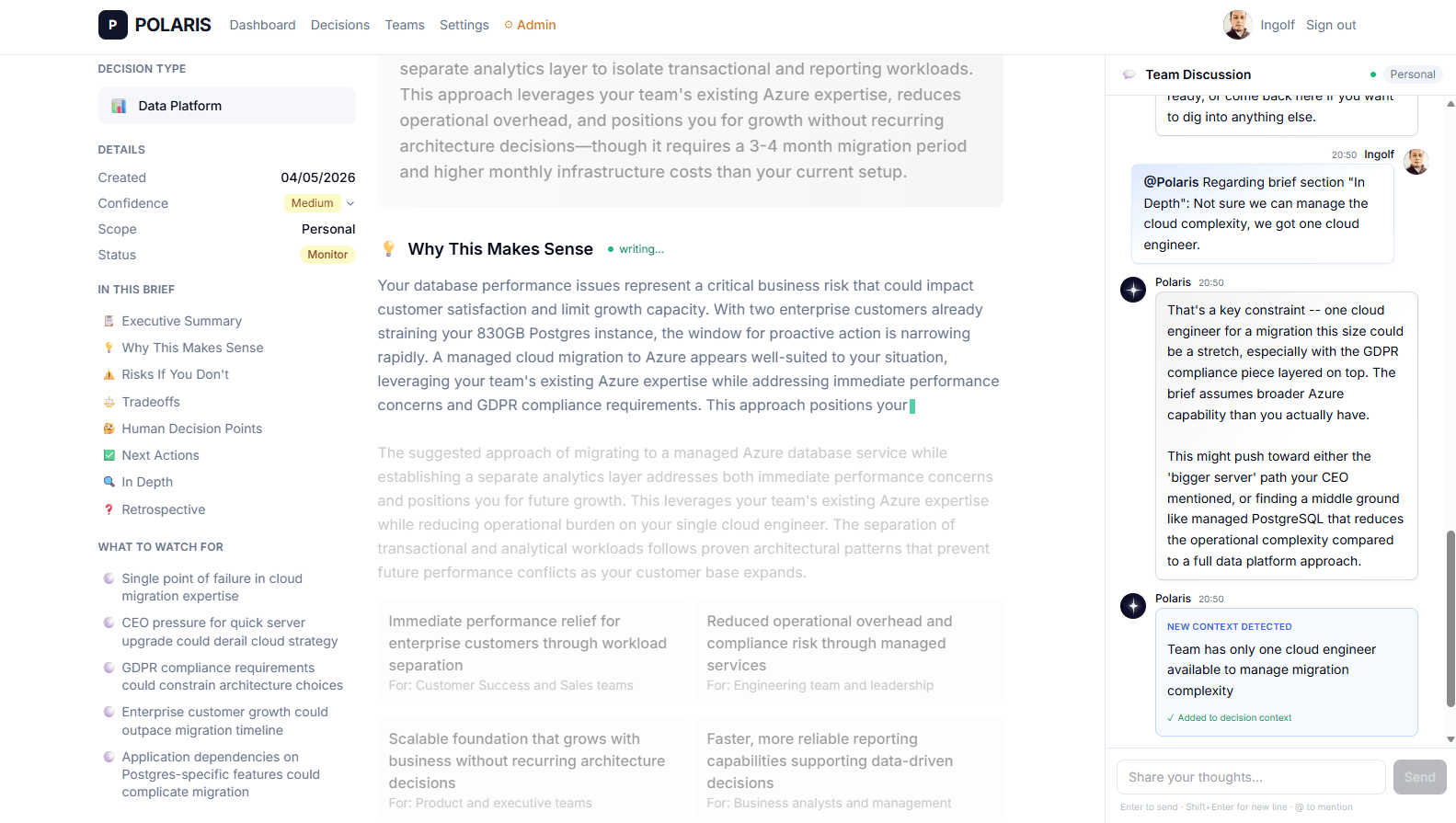
Describe your situation. Polaris guides the conversation, generates the brief, and keeps watching what happens after.
Your idea
Start with what is on your mind
Think together
Polaris asks the right questions
Brief created
Clear for every audience
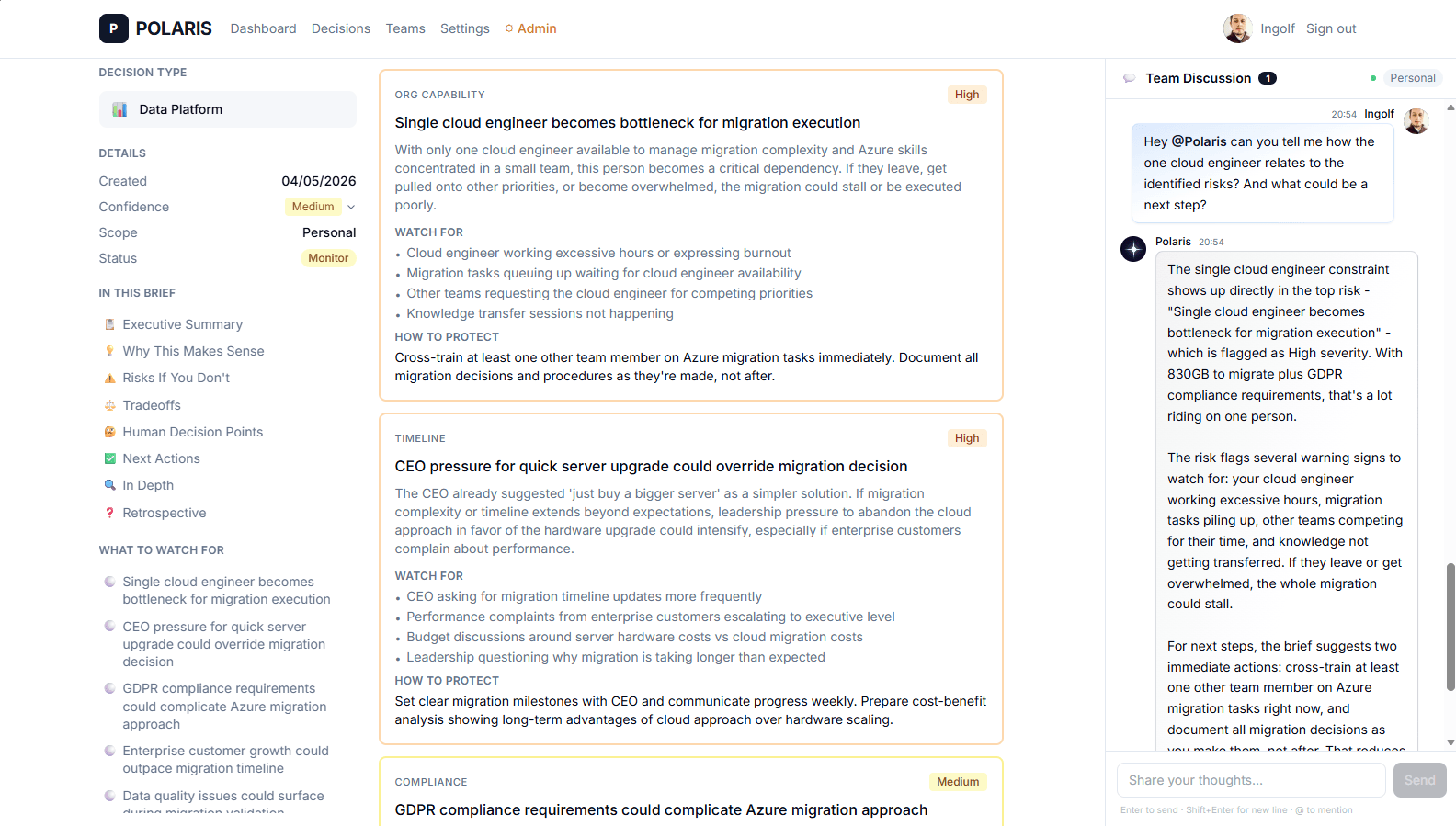
Risks captured
Independent, honest, on record
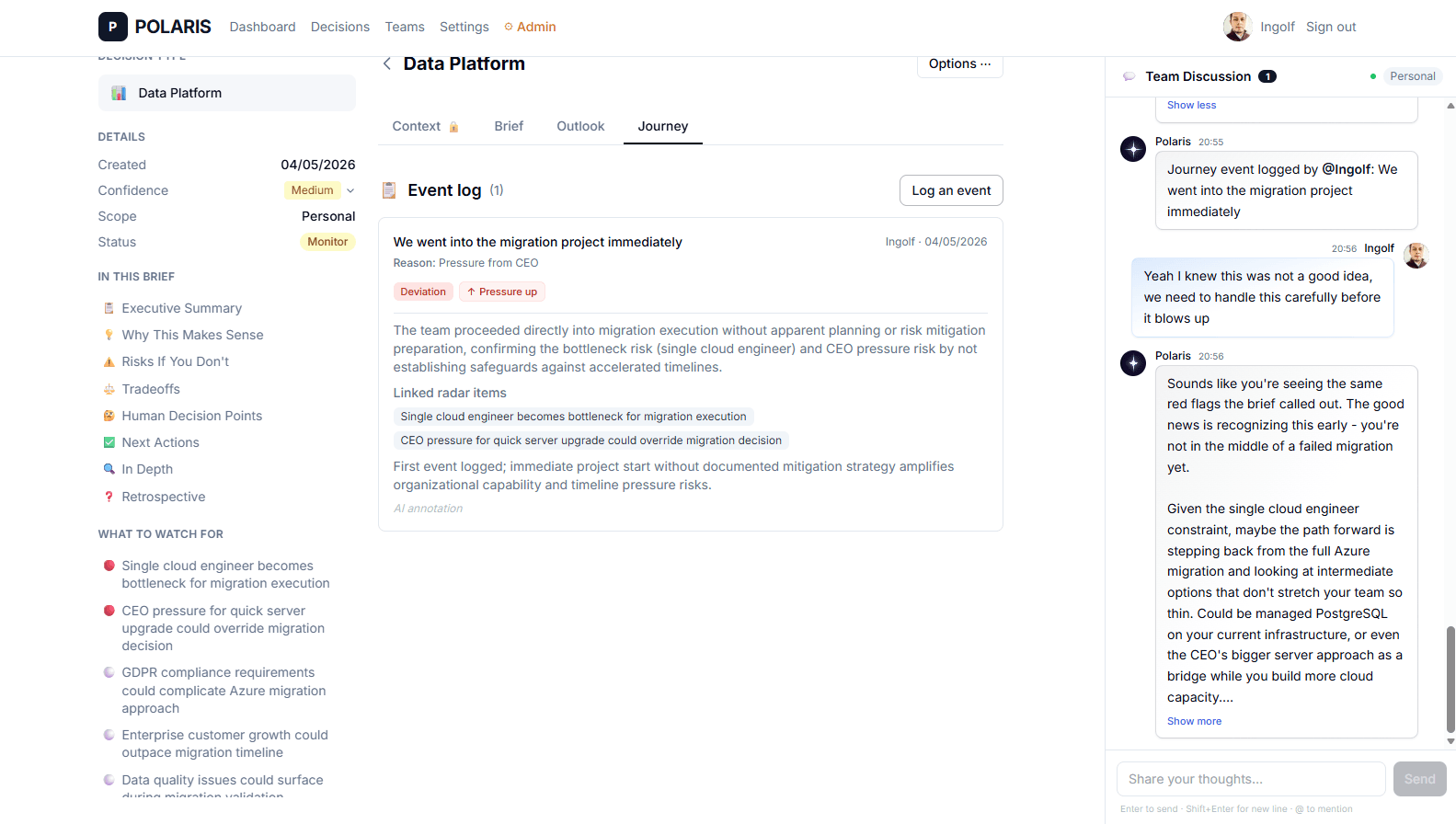
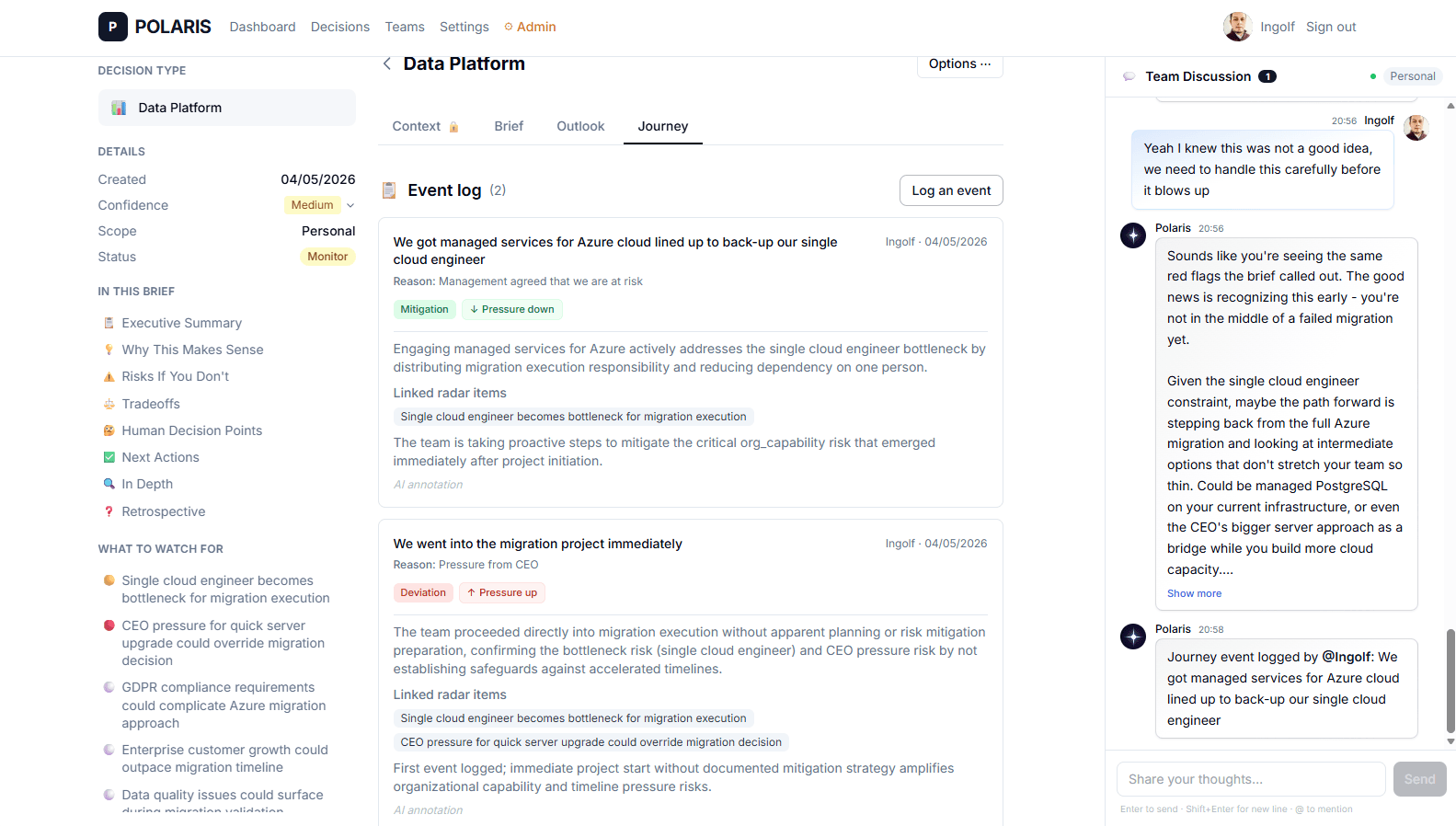
Journey logged
Track what changes over time
Stay informed
See your portfolio health
Every loop makes the decision sharper, and keeps it honest long after you've moved on.
The problem
Good decisions die after they are written down.
You spend days thinking it through. You get alignment. You write it up. Then the world changes, and nobody notices. The decision sits frozen on a page while risks quietly become real.
Most briefs start with the tech, not the people.
The conversation starts with the stack and ends with a Jira ticket. The business case, the team that inherits it, the customer who lives with it — all arrive late, if at all.
Polaris helps you prevent problems from the start.
It helps you think through the decision properly, then keeps watching, so the record stays honest even when the world around it changes.
Everything you need to decide well.
Built for architects, engineering managers, CTOs, product leaders, and anyone who owns an important call.
Decision Briefs
Structured, clear artifacts that explain the why, the tradeoffs, and what comes next. Switch between six audience modes without rewriting a word.
Architecture Playbooks
Every brief is backed by curated patterns, anti-patterns, and real-world cases, blended by decision type. Not generic AI. Accumulated knowledge from the field.
Independent Risk Panel
Risks are identified by the AI separately from your instructions and cannot be edited after the fact. The record is made before the pressure arrives.
Journey Log
Log what happens around the decision over time. Vendor acquired? Team restructured? Each event links to specific risks and shifts their status automatically.
Portfolio Outlook
See which decisions across your portfolio are healthy, under pressure, or aging badly. One view. No status meeting required.
Under 15 minutes
No setup, no training, no onboarding call. Start with a situation. Leave with a clear brief, a risk panel, and a record that will hold up when it matters.
Discussion
Talk it through. Together.
Every decision has its own thread. Polaris and your team in the same conversation.
Polaris in any thread
Use @polaris to ask a question, draft a section, or surface a related risk. It has the full context of the decision.
Threads scoped to the decision
Conversation stays with the brief, not lost in a Slack channel. Six months later, the rationale is still there.
System events in the same stream
Brief regenerations, audience switches, and journey events appear in the thread, so the team sees what changed and when.
Have we covered regional egress costs in this approach? @polaris what's the worst case at scale?
Regional egress could add €4-7k per month at expected scale. This is captured as r3 in the Risk Panel.
Good catch. Let's log a journey event once we have a mitigation lined up.
The receipt that cannot be edited
The risks are on record.
Before the pressure arrives.
When a decision gets questioned six months later, you need more than memory. The Risk Panel is generated independently by the AI. It's not shaped by your framing, and not editable after the fact.
Generated independently
The AI identifies risks separately from your brief instructions. What you wanted it to see does not influence what it flags.
Stable identifiers
Every risk gets a permanent ID (r1, r2, r3), so journey events link back to exactly what was flagged and when.
Non-editable
You can log what happens around it. You cannot change what it said.
Status updates as journey events accumulate, not as opinions change.
Coverage
Covers the decisions that slow teams down.
From platform choices to governance models to security posture.
Data Platform
Lakehouse, warehousing, migration
Choosing the wrong data platform costs years. POLARIS helps you articulate the tradeoffs between lakehouse, warehouse, and hybrid approaches, then explain that choice to engineers, executives, and procurement before anyone writes a line of code.
Integration Strategy
APIs, event-driven, middleware
Integration decisions made without a clear rationale become technical debt no one can explain. POLARIS structures your reasoning around coupling, latency, and failure modes so your team builds what you actually decided, and your stakeholders understand why.
Reporting & BI
Analytics, dashboards, self-serve
BI decisions touch everyone from the CFO to the data engineer. POLARIS helps you frame the build-vs-buy tradeoff, surface the governance implications, and produce a brief that finance, IT, and the business can all read without a translator.
Governance Model
Ownership, quality, lineage
Governance decisions are the hardest to get alignment on. Everyone agrees it matters; nobody agrees who owns it. POLARIS maps ownership, accountability, and escalation paths into a defensible brief that survives an audit and an all-hands.
Security Posture
Compliance, controls, threat models
Security decisions that live only in the CISO's head create risk. POLARIS translates your security posture into structured briefs that explain control choices, residual risk, and compliance mapping to technical and non-technical audiences alike.
Application Strategy
Portals, mobile, digital experience
Application decisions involve the most stakeholders and the most opinions. POLARIS cuts through the noise by documenting the real constraints (user needs, platform dependencies, delivery risk) and turning them into a brief your product, engineering, and leadership teams can align on.
General Decision
Any complex decision that needs structure
Not every decision fits a category, but every decision deserves structure. If you're facing a choice that's hard to explain, hard to defend, or hard to get alignment on, POLARIS gives it the same rigour as any specialised domain.
Audience modes
One decision. Every perspective.
Switch between audience modes instantly, without rewriting a word.
Architect
DefaultFull technical depth for the decision maker
The default mode. Every section, every assumption, every tradeoff at the depth you'd want when you have to defend the call yourself.
Executive
Business impact, ROI, and risk in plain language
Strips the implementation detail. Leads with what changes, what it costs, what could go wrong, and what you need from leadership to move forward.
Engineer
Implementation detail, architecture, tradeoffs
Goes deeper on the how. Architecture choices, technology selection, integration points, and the operational concerns your team will live with after launch.
Security
Controls, compliance, and threat models
Reframes the brief around the security posture. Controls, residual risk, compliance mapping, and the threat scenarios this decision changes.
Analyst
Cost-benefit, metrics, and quantitative framing
Quantifies the case. Cost lines, KPIs, sensitivity analysis, and the metrics you'd track to know whether the decision is working.
Simple pricing.
Start free. Upgrade when you are ready.
Explorer
Try it out, no commitment
Free
- 1 Decision Brief
- All audience modes
- Discuss over chat
- Outlook with risk radar
- Journey event tracking
- Team workspaces
Pro
For technical decision-makers
€21/month
- Unlimited decision briefs
- Custom brief instructions
- Brief export
- All audience modes
- Discuss over chat
- Outlook with risk radar
- Journey event tracking
- Team workspaces
Decisions do not end when you document them.
Polaris keeps watching. Your first Decision Brief is free. No credit card required.
Start a Decision